SaMD Pricing and Market Access
The optimal price for a SaMD derives from demonstrable value, not manufacturing costs. How value-based pricing, reimbursement logic and lifecycle costing interact, and how to reach the optimal price in five steps.
| Thesis | Key Statement |
|---|---|
| Pricing logic | The optimal price derives from demonstrable value for payers and users, not from manufacturing costs. Value-based pricing is the methodological standard. |
| Reimbursement pathway | The achievable price is determined by the reimbursement route. GKV, GOÄ, selective contracts and hospital settings each follow distinct pricing logic. |
| Empirical methods | Conjoint analyses, Van Westendorp surveys and price-anchor models make willingness to pay measurable and defensible in negotiations. |
| Price floor | The price floor is defined by the lifecycle cost calculation: development, regulatory and ongoing operating costs must be covered by the realistically achievable paying user base. |
| Continuity | Pricing is not a one-time decision but a continuous management task throughout the product lifecycle. |
Why SaMD Pricing Is a Discipline of Its Own
Software as a Medical Device bridges two worlds with different pricing laws: the economics of digital products with high fixed costs and near-zero marginal costs, and the regulated world of medical devices with conformity assessment, clinical evaluation and lifelong post-market surveillance. Classic cost-plus pricing systematically gives away value or fails against payer willingness to pay.
In the German healthcare system, roles are typically separated: the person benefiting from the SaMD (the patient) is rarely the same as the decision-maker (physician, clinic) or the payer (statutory health insurer, private insurer, self-payer). A sound pricing strategy therefore always answers three questions: Who realises the value? Who decides? Who pays and under what conditions?
Methodology: From Quantified Value to a Price Corridor
The starting point of value-based pricing is quantifying the benefit from the perspective of the relevant payer. Four value dimensions have proved effective in practice: clinical benefit (patient-relevant endpoints, quality of life, safety), health-economic benefit (avoided hospitalisations, reduced complication rates), process and structural benefit (time savings, improved adherence, documentation quality) and strategic benefit (competitive differentiation, new billable services, data value).
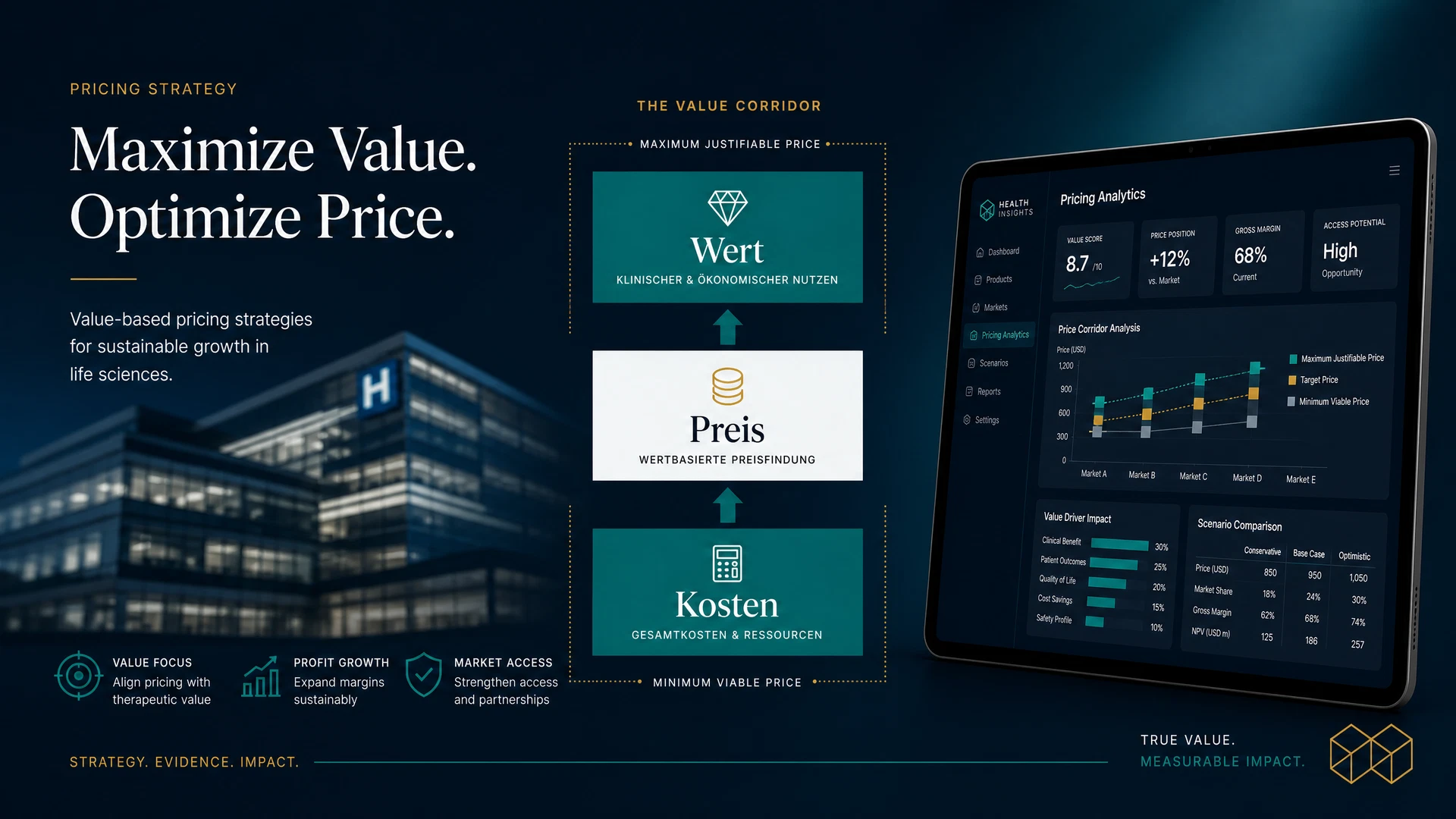
These dimensions define the price ceiling: the monetised value for the relevant payer. The price floor is set by total lifecycle costs. Within this corridor, the optimal price is determined empirically. Gensorowsky et al. have developed the price-anchor approach for digital health solutions in the German market and demonstrated how wide the range of freely set prices is in practice.
Empirical Instruments for Price Validation
| Method | Core question | Typical use |
|---|---|---|
| Payer and expert interviews | Which value arguments does the payer accept? What evidence is required? | Early phase, qualitative foundation of the value story |
| Van Westendorp analysis (Price Sensitivity Meter) | Which price range is perceived as acceptable by target customers? | Screening realistic price ranges |
| Conjoint / Discrete-Choice analysis | How much is each feature worth? Which packages maximise revenue? | Feature prioritisation, tiered and bundle pricing |
| Price anchor / indifference price | What does the established standard of care cost per outcome unit? | Negotiation argument with health insurers |
| Budget-impact / cost-effectiveness model | What does the payer save net per insured per year? | Selective contracts, proof of cost-effectiveness |
Simon-Kucher notes that price realisation in medtech fails less on methodology than on value communication: in an industry survey, around 60 per cent of companies cited convincing customers as the biggest obstacle to price increases. Value argumentation and evidence therefore belong in product development from the outset.
Reimbursement Defines the Price Framework: GKV and GOÄ at a Glance
No SaMD price can be set independently of the reimbursement pathway. Each access route has its own pricing mechanism and its own implications for pricing strategy:
| Access route | Pricing mechanism | Implication for the manufacturer |
|---|---|---|
| Outpatient care (EBM, § 87 SGB V) | The Joint Federal Committee reimburses the physician service; the software itself is generally not reimbursed separately. | B2B price to practice or MVZ; amortisation via efficiency gains or newly billable services. |
| Medical aids directory (§ 139 SGB V) | Contracts and flat-rate fees per health insurer; joining framework agreements is possible. | Price negotiation per insurer; listing requires alignment with existing product groups. |
| Selective contracts (§ 140a SGB V) | Freely negotiated remuneration with individual health insurers. | High pricing flexibility but fragmented market access; proof of savings and benefit is central. |
| Hospital (DRG/OPS, NUB under § 6(2) KHEntgG) | SaMD is included in treatment costs; time-limited NUB fees for innovations. | B2B price to the clinic; business case via revenue, process and quality effects. |
| Private practice (GOÄ) and self-payers | Billing of physician services; digital services currently mostly billed by analogy under § 6(2) GOÄ; manufacturer price freely set. | Often the fastest revenue channel with free pricing scope, but limited volume. |
| DiGA (§§ 33a, 134 SGB V) | Free manufacturer price in the first year, then negotiation with the GKV-Spitzenverband. | Regulatory special pathway with its own pricing logic; covered in a separate Impulse. |
Two points deserve particular attention. In the GKV, the manufacturer is rarely a direct contracting party with the insurer; the price is often realised indirectly via cost-effectiveness at the care provider. In private practice, many digital services still lack a dedicated fee schedule position. The German Medical Association has initiated the GOÄ revision, but its entry into force remains pending. Until then, analogous billing under § 6(2) GOÄ remains the instrument of choice.
Manufacturer Economics: The Lifecycle Counts
Value-based pricing defines the ceiling; the manufacturer's own cost structure sets the floor. At SaMD, this is frequently underestimated because regulatory approval is not the end but the beginning of the regulatory cost curve. One-time costs include development under IEC 62304 and IEC 62366-1, risk management under ISO 14971, clinical evaluation, building the quality management system under ISO 13485, and conformity assessment including a Notified Body from Class IIa under MDR. Ongoing costs arise from post-market surveillance and PMCF, vigilance, surveillance audits and re-certification, updates and cybersecurity maintenance, hosting and operations, and support and training.
The price floor equals annualised one-time costs plus annual operating costs, divided by the realistically achievable paying user base. This calculation should be stress-tested conservatively, as adoption speed in the German healthcare market is regularly overestimated. On the revenue side, annual licences or subscription models per site or workstation, usage-based fees per case, and tiered packages by feature scope have become established. Outcome-based components are gaining traction and fit conceptually with the value-based approach.
Practical Guide: Five Steps to the Optimal Price
| Step | Task |
|---|---|
| 1. Map the payer landscape | Identify reimbursement routes, decision-makers and budget logic per target segment (GKV routes, GOÄ/PKV, self-payers, hospital). |
| 2. Quantify value | Monetise clinical, economic and process benefit per stakeholder; build a budget-impact model. |
| 3. Validate the price corridor | Test willingness to pay empirically (interviews, Van Westendorp, conjoint); derive price anchor from the standard of care. |
| 4. Design the pricing model | Align price metric, package structure and contract form with the payer's value realisation; cross-check lifecycle costs as the floor. |
| 5. Execute and recalibrate | Back the value story with evidence, establish pricing as a continuous process with clear ownership, and calibrate regularly against market data. |
Conclusion
The optimal SaMD price is not a calculation result from cost accounting but the outcome of a methodical process: quantify value, validate willingness to pay empirically, factor in the reimbursement logic of each access route, and respect the lifecycle cost calculation as a hard floor. Manufacturers who set up this process early, in parallel with clinical and regulatory strategy, negotiate from a position of strength. Those who defer it until after CE marking hand price formation to the payer.
Sources: [1] Gensorowsky, D. et al. (2022): Market access and value-based pricing of digital health applications in Germany. Cost Effectiveness and Resource Allocation 20:25. https://doi.org/10.1186/s12962-022-00359-y · [2] Simon-Kucher (2024): Prioritizing pricing excellence for sustainable growth in medtech and diagnostics. simon-kucher.com · [3] Simon-Kucher: Value-based Pricing Strategy. simon-kucher.com · [4] German Medical Association: GOÄ revision. bundesaerztekammer.de · [5] Legal basis: §§ 87, 139, 140a SGB V; § 6(2) KHEntgG; § 6(2) GOÄ; Regulation (EU) 2017/745 (MDR).
Do you have a concrete project?
Talk to us about your project, no obligation, at eye level.
Schedule a conversation