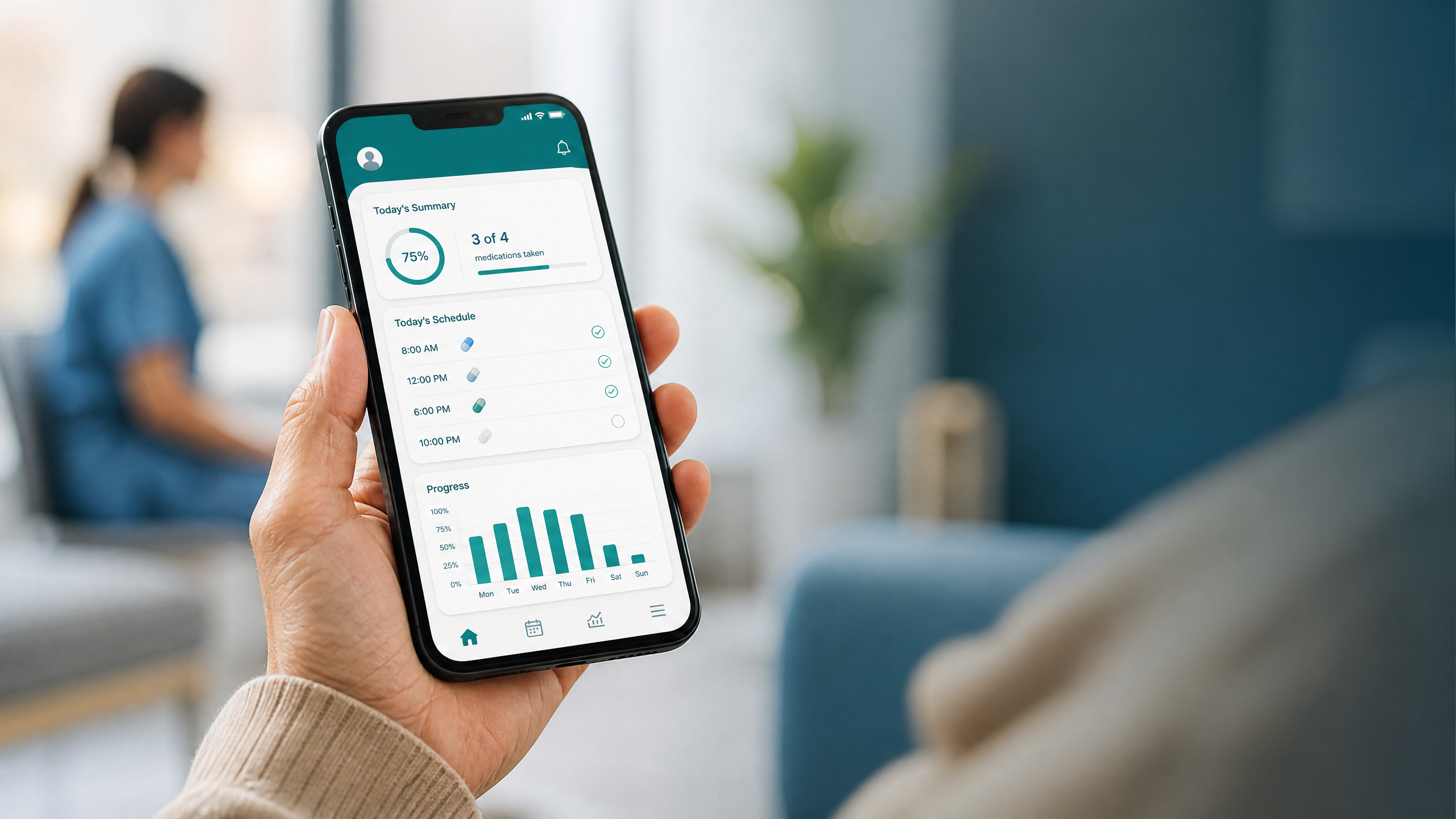
Pharma Apps and Patient Adherence
Around 50% of patients with chronic conditions do not take their medication as prescribed. Companion apps address this problem while creating value for patients, payers and pharmaceutical companies.
Around 50% of patients with chronic conditions do not take their medication as prescribed. This figure comes from a WHO report published in 2003 and remains valid today. The downstream costs are substantial: in England, poor medication adherence generates annual costs exceeding £930 million; in the United States, estimates range from $100 billion to $300 billion per year.
Companion apps, digital applications that accompany a medication or therapy, offer a structured approach to addressing this problem. They support patients throughout the entire treatment journey: from diagnosis through therapy initiation to long-term adherence. At the same time, they create value for all stakeholders in the healthcare system.
What is a companion app?
A companion app is a digital health application that complements a pharmacological therapy. It can be therapy-specific, meaning it is designed exclusively for patients on a particular medication, or disease-specific and therefore independent of the chosen treatment. Typical features include medication reminders, symptom tracking, educational content, communication with the care team, and real-world data collection.
The global disease management app market was valued at USD 7.6 billion in 2022 and is projected to grow to approximately USD 20 billion by 2032.
Evidence: What the science says
The efficacy of app-based adherence interventions is scientifically established. A systematic review with meta-analysis published in BMJ Open (Armitage et al., 2020) analysed nine randomised controlled trials with 1,159 participants. The finding: patients using an adherence app were significantly more likely to report medication adherence than control groups (OR 2.12; 95% CI 1.64 to 2.75).
A further meta-analysis in the Journal of Managed Care & Pharmacy (Peng et al., 2020) confirms this effect across multiple indications. The studies show that behaviour change techniques such as reminders, self-monitoring, and feedback are the core mechanisms driving the adherence effect.
Value for patients
For patients, higher adherence primarily means better clinical outcomes. Companion apps support this on several levels: automated medication reminders, symptom tracking with reports for clinical consultations, educational content about the condition and therapy, and a continuous connection to the care team between appointments.
A concrete example comes from an oncology programme by RxPx: for an oral cancer therapy where clinical trials had shown a 50% discontinuation rate within the first eight weeks, 97% of app users remained active for at least 90 days. The industry average is 31%. After one year, 70% remained active, compared with 18% in the industry average.
Value for payers
For health insurers, medication adherence is a central lever for cost reduction. Non-adherent therapies lead to avoidable hospitalisations, complications, and follow-on treatments. One study estimates that app-based technology could save £7.5 billion in England alone through reduced pressure on general practitioners and improved medication adherence.
Companion apps also generate real-world data that can be used in health technology assessments and reimbursement negotiations. They document how patients use a medication in everyday life, creating an evidence base that clinical trials alone cannot provide.
Value for pharmaceutical companies
For pharmaceutical companies, companion apps offer four strategic levers. First, apps help identify eligible patients and reduce barriers to prescribing. Second, improved adherence can increase sales volume by 3% to 20% depending on the therapeutic area (Deloitte, 2021). Third, apps enable decentralised trial designs and reduce recruitment costs, which account for up to 32% of total clinical trial costs. Fourth, a therapy-specific companion app can be classified as a combination product, potentially extending market exclusivity.
The mySugr example
mySugr, founded in Vienna in 2012 and acquired by Roche in 2017, is one of the best-known companion apps in diabetes care. The app enables the recording of blood glucose values, meals, insulin doses, and physical activity. It is available in more than 150 countries and has over 4 million users.
A randomised controlled trial (Singh et al., 2025, Primary Care Diabetes) shows that the mySugr app increases patient engagement with their therapy. A further study (Cuixart et al., 2025, Hormones) confirms positive effects on glucose-related parameters in type 2 diabetes when combined with teleconsultations. The example illustrates how a companion app can go beyond pure adherence support and become a central element of therapy management.
Challenges and success factors
Companion apps only realise their potential when certain conditions are met. Merck KGaA identifies five key barriers in an analysis: dependence on physician recommendation, poor user experience, lack of interoperability with existing IT systems, concerns about the doctor-patient relationship, and insufficient patient engagement.
Successful companion apps are characterised by early patient involvement in the development process, clear clinical evidence, seamless integration into existing care pathways, and a sustainable business model.
Conclusion
Companion apps are not an add-on. They are a strategic instrument. They improve clinical outcomes for patients, reduce costs for payers, and increase the value of pharmacological therapies for manufacturers. The scientific evidence is there. The technological prerequisites are in place. The decisive question is whether pharmaceutical companies are prepared to make the necessary investments in user-centred design, clinical validation, and market integration.
Sources: Armitage LC et al.: Do mobile device apps designed to support medication adherence demonstrate efficacy? BMJ Open, 2020. RxPx: Oncology Adherence Program Case Study, 2024. Merck KGaA: Companion Apps in Healthcare, 2024. Alex Therapeutics: The Business Case for Pharma Investing in Digital Companions, 2024. Deloitte: Importance of Personalized Therapies, 2021.
Do you have a concrete project?
Talk to us about your project, no obligation, at eye level.
Schedule a conversation